
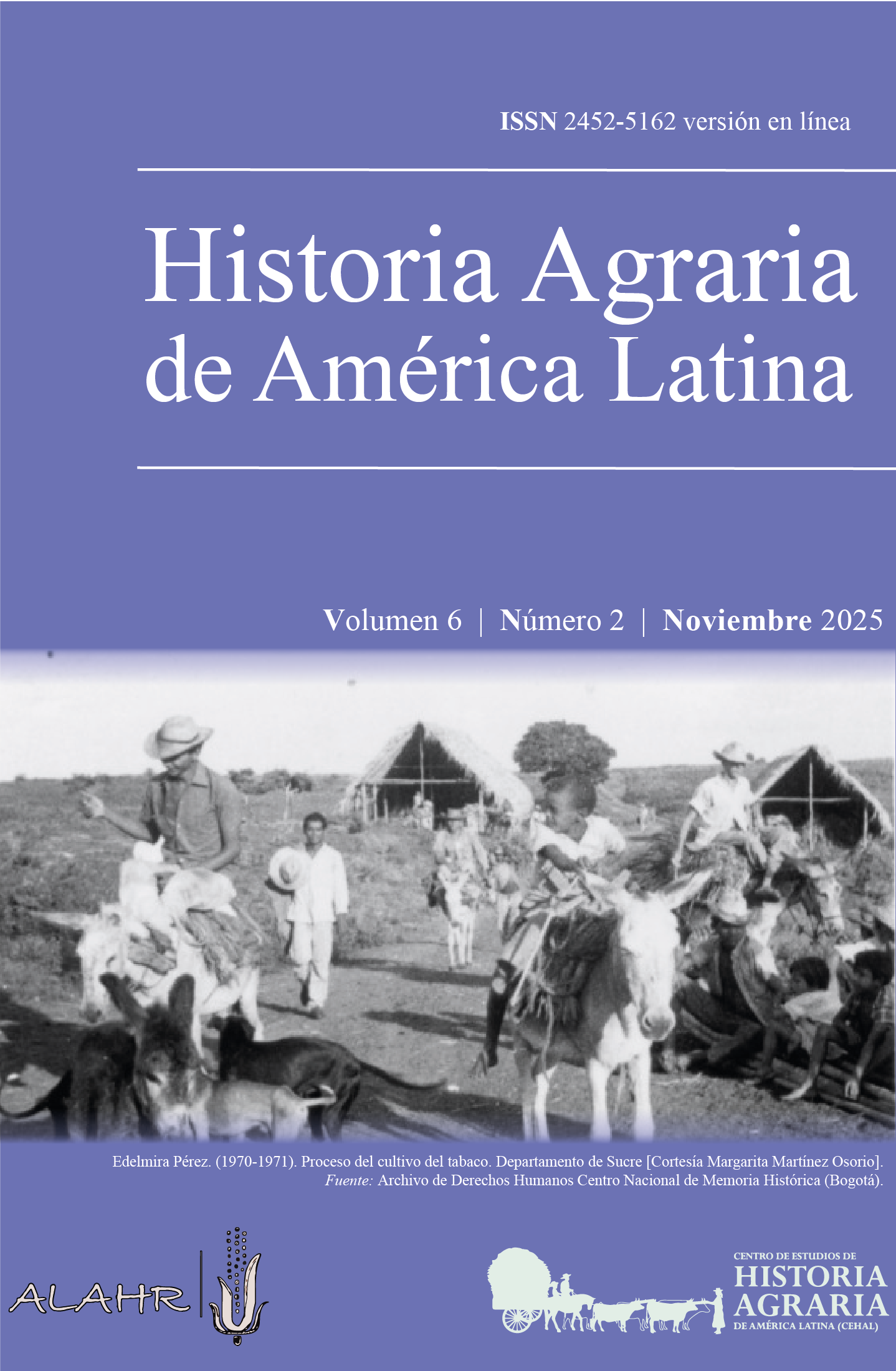
The Struggle for Communal Lands in the Colombian Caribbean: The Gendered Labor of Peasant Women and Children during the Early Years of Agrarian Reform

- reforma agraria,
- movilización campesina,
- trabajo productivo y reproductivo,
- género,
- Caribe colombiano
Vistas al resumen: 477 | Descargas: 814
Resumen
The Colombian Caribbean region has one of the most unequal agrarian structures in Latin America, shaped by the rise of large cattle estates and agricultural booms in the late nineteenth and early twentieth centuries. The Agrarian Reform Law of 1961 provided an opportunity to challenge this regime of land accumulation. This article explores the roles of peasant women and children in both sustaining productive and reproductive labor within the Caribbean large estate and during the peasant mobilization in the 1960s, the early years of agrarian reform. It argues that when peasants mobilized to occupy communal lands in the agrarian reform context, women and children actively transformed the reproductive labor they used to perform on the estates into collective efforts that sustained peasant mobilization by protecting Caribbean peasant communities from precarity and defending the commons as the possibility to sustain life and care outside of the logic of large estate expansion.
Cómo citar
Derechos de autor 2025 Margarita María Martínez Osorio

Esta obra está bajo una licencia internacional Creative Commons Atribución-NoComercial-SinDerivadas 4.0.
Citas
- Berman-Arévalo, E. (2021). Geografías negras del arroz en el Caribe Colombiano: Tongueo y cuerpo territorio ‘en las grietas’ de la modernización agrícola. Latin American and Caribbean Ethnic Studies. https://doi-org.proxyiub.uits.iu.edu/10.1080/17442222.2021.2009638
- Berman-Arévalo, E., & Ojeda, D. (2020). Ordinary Geographies: Care, Violence, and Agrarian Extractivism in “Post-Conflict” Colombia. Antipode. A Radical Journal of Geography, 54, No 6, 1583–1602. https://doi-org.proxyiub.uits.iu.edu/10.1111/anti.12667
- Butler, J., & Athanasiou, A. (2013). Dispossession: The Performative in the Political. Polity Press.
- Cely Forero, A. M. (2022). Las mujeres y la reproducción social de la lucha campesina en Colombia. Revista Controversia, 219, 129–172. https://doi.org/10.54118/controver.vi219.1266
- Colmenares Guerra, S. (2024, November). “The best lands have been taken”: El proceso de acumulación de tierras de la United Fruit Company a lo largo de la frontera del banano en el Gran Caribe, 1900-1940. Revista de Historia Agraria de América Latina, 5(2), 29–55. https://doi.org/10.53077/haal.v5i02.217
- De la Rosa Carriazo, S. (2024, May). Peasant mobilisation and democratisation in Latin America: Reducing political inequalities in Montes de María, 1950-2000. Revista de Historia Agraria de América Latina, 5(1), 87–105. https://doi.org/10.53077/haal.v5i01.165
- Deere, C. D. (1995). What Difference does Gender Make? Rethinking Peasant Studies. Feminist Economics, 1(1), 53–72. https://doi-org.proxyiub.uits.iu.edu/10.1080/714042214
- Deere, C. D., & León, M. (Eds.). (1986). La mujer y la política agraria en América Latina. Siglo Ventiuno.
- Deere, C. D., & León, M. (2002). Género, propiedad y empoderamiento: Tierra, estado y mercado en América Latina (2a ed). UNAM : FLACSO.
- Fals Borda, O. (1980). Historia doble de la Costa. Mompox y Loba (Vol. 1). Carlos Valencia Editores.
- Federici, S. (2015). Calibán y la bruja. Mujeres, cuerpo y acumulación originaria. Tinta Limón.
- Federici, S. (2019). Re-Enchanting the World: Feminism and the Politics of the Commons. PM Press.
- Guerra, A. (2020). El movimiento gaitanista en el Caribe colombiano, 1928-1948. La Carreta Editores.
- Gutiérrez Sanín, F., Villamil Castellanos, P. A., & Pedraza Norato, E. J. (2023). Las invasiones y las reformas agrarias durante el Frente Nacional: Una reconsideración. In F. Gutiérrez Sanin (Ed.), Las reformas agrarias del Frente Nacional. Reabriendo el caso (pp. 283–320). Universidad del Rosario.
- LeGrand, C. (1988). Colonización y protesta campesina en Colombia 1850-1950 (Universidad Nacional de Colombia).
- Lozano, S. P. (2010). Del ‘antilatifundismo sociológico’ al revisionismo historiográfico. La ganadería en la historiografía sobre la región Caribe colombiana. Mundo Agrario, 10(20), 1–38.
- Machuca Pérez, D. X. (2023). El campesinado como interlocutor de la política agraria: La experiencia de la Asociación Nacional de Usuarios Campesinos. In Las reformas agrarias del Frente Nacional. Reabriendo el caso (pp. 155–198). Universidad del Rosario.
- Meertens, D. (2000). Ensayos sobre tierra, violencia y género. Hombres y mujeres en la historia rural de Colombia, 1930-1990. Universidad Nacional.
- Meertens, D. (2020). Elusive Justice Women, Land Rights, and Colombia’s Transition to Peace. University of Wisconsin Press.
- Meillassoux, C. (1977). Mujeres, graneros y capitales. Economía doméstica y capitalismo. Siglo XXI Editores.
- Ocampo, G. I. (2007). La instauración de la ganadería en el valle del Sinú: La hacienda Marta Magdalena, 1881-1956. Universidad de Antioquia.
- Ojeda, D. (2021). Social Reproduction, Dispossession, and the Gendered Workings of Agrarian Extractivism in Colombia. In B. McKay, A. Alonso-Fradejas, & A. Ezquerro-Cañete (Eds.), Agrarian Extractivism in Latin America. Routledge.
- Ojeda, D. (2022). El punto ciego de la propiedad: Género, tierra y despojo en América Latina. Trace, 81, 107–132.
- Patiño Niño, D. M. (2025). Las mil caras de la lucha: Juana Julia Guzmán y su legado. Universidad de los Andes, Ediciones Uniandes.
- Posada Carbó, E. (1998). El Caribe colombiano: Una historia regional (1870-1950). Banco de la República.
- Rappaport, J. (2020). Cowards don’t Make History. Orlando Fals Borda and the Origins of Participatory Action Research. Duke University Press.
- Reyes Posada, A. (1978). Latifundio y poder político: La hacienda ganadera en Sucre. CINEP.
- Rivera Cusicanqui, S. (1982). Política e ideología en el movimiento campesino colombiano: El caso de la ANUC. CINEP.
- Robles-Ortiz, C. (2018). Revolution from below in Panguipulli: Agrarian reform and political conflict under the Popular Unity in Chile. Journal of Agrarian Change, 18, 606–631. https://doi.org/10.1111/joac.12241
- Sibaja Madera, F. (2023, November). Fuego y ganadería en el valle de los ríos Sinú y San Jorge (Caribe colombiano), en el siglo XX. Revista de Historia Agraria de América Latina, 4(2), 90–109. https://doi.org/10.53077/haal.v4i02.176
- Stolcke, V. (1995). The Labors of Coffee in Latin America: The Hidden Charm of Family Labor and Self-Provisioning. In W. Roseberry, L. Gudmundson, & M. Samper Kutschbach (Eds.), Coffee, Society, and Power in Latin America. The Johns Hopkins University Press.
- Van Ausdal, S. (2009). Potreros, ganancias y poder. Una historia ambiental de la ganadería en Colombia, 1850-1950. Historia Crítica, 1 (39E), 126–149. https://doi.org/10.7440/histcrit39E.2009.07
- Van Ausdal, S. (2022). The Nature of Failure: The Protracted Demise of the American-Colombian Corporation, 1909–1960. Enterprise and Society, 23(3), 640–679. https://doi.org/10.1017/eso.2020.74
- Zamosc, L. (1986). The Agrarian Question and the Peasant Movement in Colombia: Struggles of the National Peasant Association, 1967-1981. Cambridge University Press.