
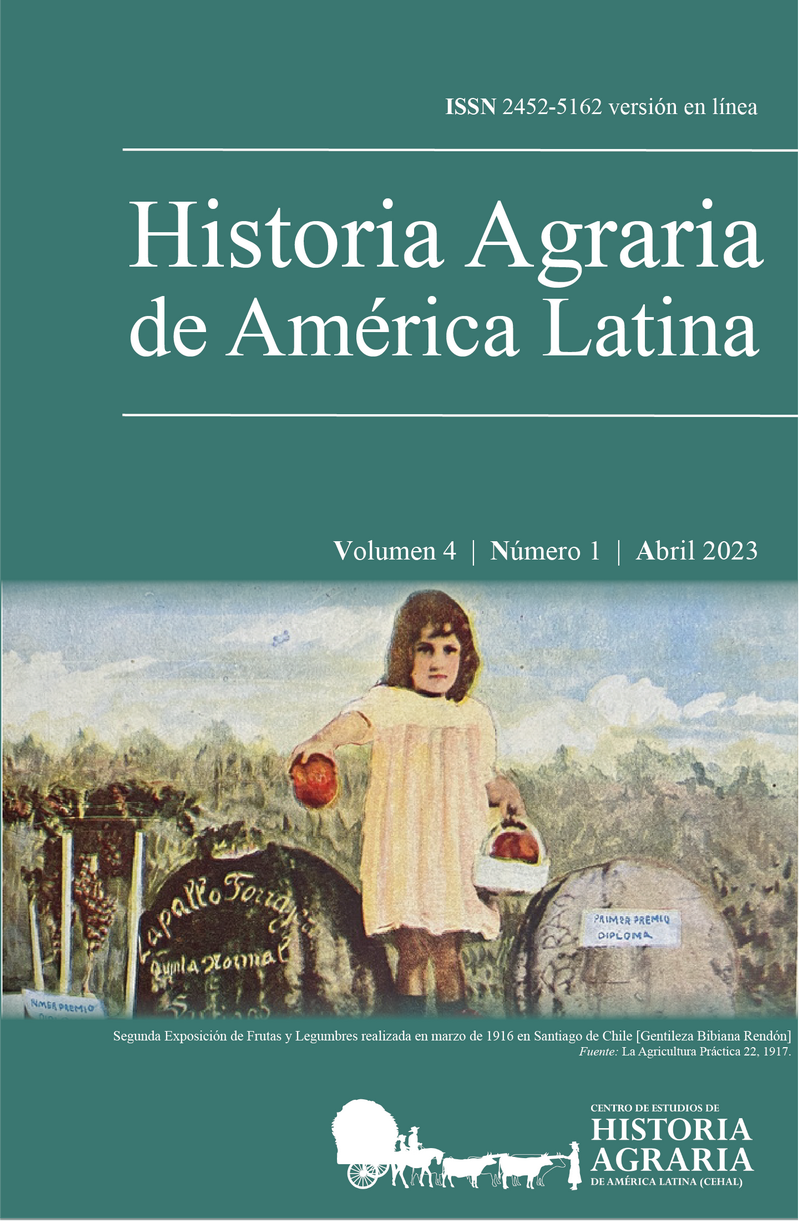
Tabla de Contenidos
Vol. 4Núm. 01abril 2023
Artículos
Abstract
Ver Artículo
Descargar PDF
Descargar PDF
La provincia de Jujuy, ubicada en el norte de la actual Argentina, presenta una amplia heterogeneidad regional. Esto derivó en diversas formas de tenencia y propiedad de la tierra en su territorio. La historiografía existente ha analizado ampliamente este proceso, aunque aún no se ha centrado en una región particular, los Valles Centrales, especialmente durante la segunda mitad del siglo XIX. En este artículo analizamos el complejo proceso de emergencia y estructuración del mercado de tierras y el peso que tenían los derechos de agua para riego en la valorización del suelo.
Abstract
Ver Artículo
Descargar PDF
Este artículo examina la expansión de la industria de conservas de fruta en Chile entre fines del siglo XIX y durante las primeras décadas del s. XX. Este proceso fue el resultado de la iniciativa de empresarios innovadores, quienes, en su mayor parte, no eran parte de las elites empresariales ni de la clase de grandes terratenientes que dominaba la agricultura de Chile Central. Estos nuevos industriales desarrollaron la producción en gran escala de conservas de frutas, hortalizas y legumbres, por medio de la integración vertical y conectando la emergente fruticultura especializada con un sub-sector industrial de alimentos orientado principalmente al mercado interno. A diferencia del empresariado asociado a la exportación de materias primas, los industriales conserveros invirtieron las utilidades para expandir la producción y modernizar sus fábricas. Asimismo, como en otros sectores, la industria de conservas fue formada por empresarios chilenos y extranjeros, quienes crearon sólidas empresas familiares que, en algunos casos, tuvieron una larga trayectoria.
Abstract
Ver Artículo
Descargar PDF
Este artículo expone los aspectos más salientes de las luchas por la tierra en el norte uruguayo entre 1959 y 1973. La relevancia de este estudio radica en tres aspectos. Primero, el alto nivel de concentración de la propiedad agraria en el departamento de Artigas. Segundo, la emergencia de la Unión de Trabajadores Azucareros de Artigas (UTAA), que reclamaba acceder a un latifundio de 30 mil hectáreas. Tercero, la creciente presencia que el Estado comienza a tener en ese territorio a través del Instituto Nacional de Colonización (INC) a finales de los años sesenta mediante la expropiación y compra de tierras con fines colonizadores. Los resultados muestran que los asalariados de la caña de azúcar no fueron contemplados como beneficiarios en la adjudicación de tierra, a pesar de haber impulsado la expropiación de los latifundios que en 1970 pasaron a manos del INC.
Abstract
Ver Artículo
Descargar PDF
En 1971 el director sueco Jan Lindqvist realiza en la comunidad de Churo (Cusco, Perú) el documental testimonial Agripino, donde los campesinos de la localidad denuncian en primera persona los abusos a los que se han visto sometidos por el hacendado en un contexto de implementación de la Reforma Agraria. Luego de 50 años, la película regresa a la comunidad y, a partir de ello, decidimos hacer un nuevo filme en la misma zona: Buenos días, wiraqocha. ¿Qué impactos tuvo la ejecución de la Reforma Agraria en las personas que habitaron dicha comunidad?, ¿es posible construir, de forma conjunta, la representación de sus memorias en un documental?, ¿qué metodologías emplear para este nuevo proyecto?
Abstract
Ver Artículo
Descargar PDF
Este artículo busca analizar y situar el reciente auge de la actividad minera en las comunidades campesinas del distrito de Colquemarca (Cusco, Perú), como un proceso dentro de la trayectoria histórica del empoderamiento político campesino en la región sur andina del Perú. Sostenemos que existe una continuidad entre las luchas por la tierra impulsadas por las comunidades campesinas contra el régimen de hacienda en el siglo XX y las luchas por el acceso y usufructo del subsuelo en los territorios comunales que se llevan a cabo en la actualidad. Esta continuidad se basa en una pugna por el control del territorio que sigue dándose frente a la antigua élite local y a otros actores como el Estado peruano y las grandes empresas mineras, lo cual ha convertido este problema en un eje que articula la actividad política local. En ese sentido, las demandas por el derecho a explotar recursos territoriales –que se amplían, en este caso, desde la tierra a los minerales del subsuelo– son comprendidas por las familias y organizaciones comunales como formas de reivindicación y autodeterminación territorial locales, así como también expresiones de una lucha histórica por una mayor autonomía y soberanía.
Abstract
Ver Artículo
Descargar PDF
La transición nutricional chilena implicó cambios significativos en la dieta entre 1990 y 2000, destacando el rápido aumento del consumo de carnes y lácteos como fuentes principales de proteínas y calorías. En este trabajo se analiza el consumo aparente de legumbres entre 1966 y 2018, un tipo de alimento cuya disminución constituye otra tendencia relevante. Los principales resultados indican disminución en el consumo aparente per capita de porotos, garbanzos y arvejas, mientras que el de lentejas presenta un leve aumento. Además, se establece que los niveles socioeconómicos que destinan una mayor proporción de su ingreso a legumbres son aquellos en el tercer quintil. A continuación, se explican los principales impactos de la dieta en términos de salud pública, los cuales permiten considerar que el país experimentó una transición nutricional no saludable. Finalmente, se presentan los beneficios que una mayor ingesta de proteína vegetal procedente de las legumbres podría tener en una eventual nueva fase de la transición nutricional.