
Vol 7No 01May 2026
Table of Contents
Vol 7No 01May 2026
Articles
Abstract
View Article
Download PDF
This paper presents and analyzes the evolution of the ratio between urban wages and the price of wheat land in Argentina, as these indicators can, in an impressionistic manner, act as a proxy for long-term factor returns. It also examines whether this ratio followed the same pattern in other countries. To this end, a comparison is made with Canada and the United States to assess possible convergences and/or divergences in this ratio and to understand their reasons. First, an initial convergence and a process of divergence in Argentina's ratio since the mid-20th century were observed. Second, the evolution of land prices was similar in all three countries. Finally, it was found that Argentine wages followed a different trend than those in other countries.
Abstract
View Article
Download PDF
This article analyzes the development of capitalist globalization from the mid-20th century to the present, using value chains as an analytical framework to examine the trajectories of various coffee economies in the province of Loja (Ecuador). The analysis is based on a review of production practices, marketing strategies, and modes of territorialization over a time span that begins in 1962, when Ecuador joined the International Coffee Agreement (ICA), and extends to the present. The study adopts a diachronic methodological approach, implemented through multi-sited ethnography. It concludes that during the study period, the reorganization of the coffee economy in Loja has been consolidated through classification systems that function as mechanisms for organizing production and trade practices, as well as for differentiating the various social groups that shape and sustain the coffee economy.
Abstract
View Article
Download PDF
Download PDF
This article studies the economic dynamics of wheat production in the Argentine Pampas during its rapidly expanding period (1890-1914), with a specific focus on production costs. The methodological framework integrates a regional overview with a disaggregated analysis of the four Pampean provinces. The main findings suggest that while the sector initially achieved sustained profitability through favorable international prices and controlled costs, the situation began to deteriorate after 1910. This trend was due to a combination of rising costs and declining yields resulting from the shift toward more land-extensive farming units onto less productive lands. The research is grounded in a comprehensive database constructed from primary sources, such as national censuses, contemporary technical reports, and official data from the Ministry of Agriculture's Statistics Division.
Dossier: Land, labour and resistances of rural women in Latin America, the Caribbean and the Global South (Part I)
Abstract
View Article
Download PDF
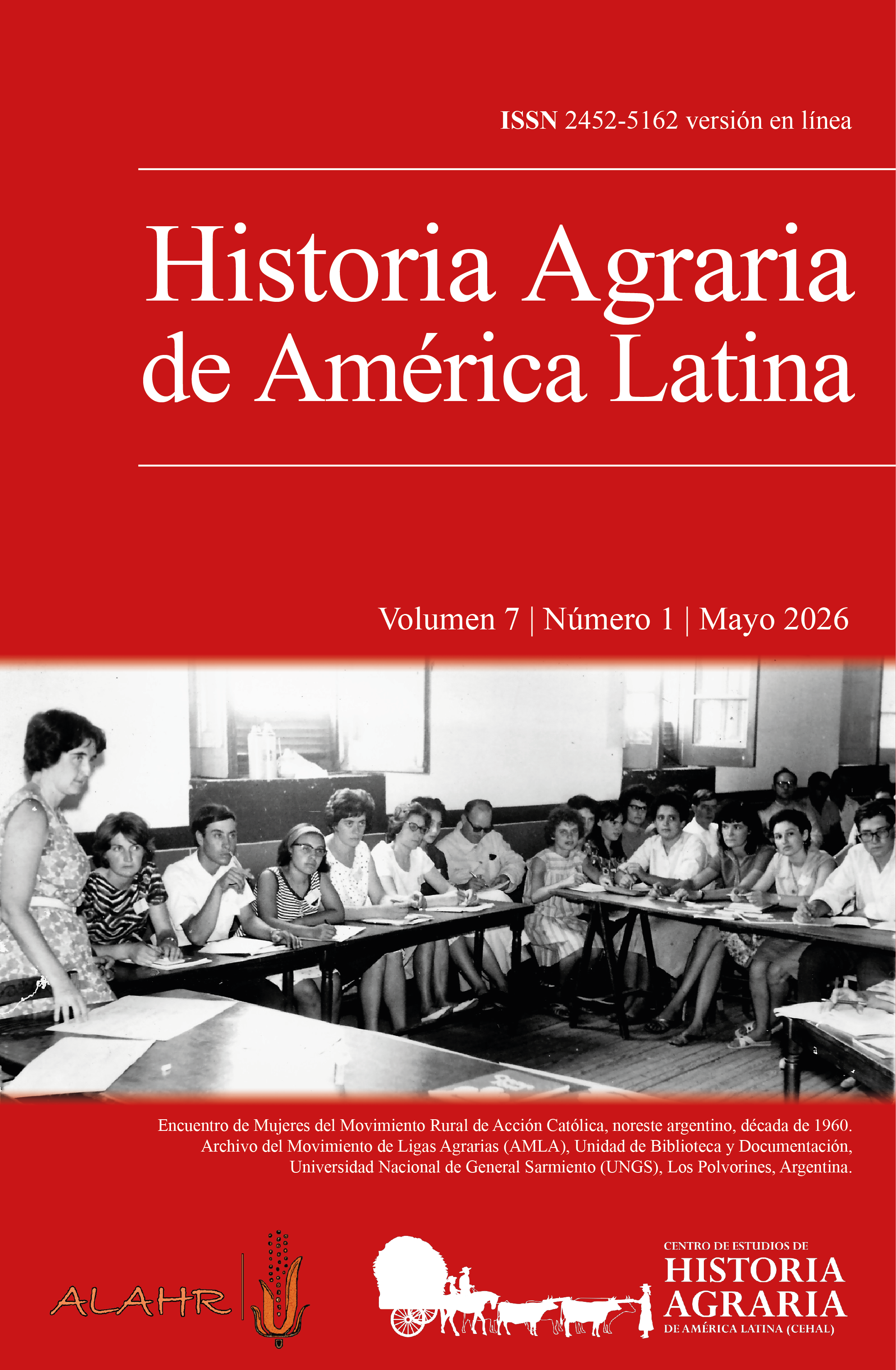
This article examines the politics of women in the Agrarian Leagues and the Christian Rural Movement in northeastern Argentina, focusing on their forms of participation and intervention in rural territories. This is a topic that has received scant attention, both in the field of rural studies and in studies of memory and recent history in Argentina. Indeed, the political participation of peasant women has been rendered invisible, even in experiences where grassroots organizing was driven entirely by rural families—living spaces whose organization and reproduction are typically ensured by women. Specifically, this work studies the history of the Agrarian Leagues and the Christian Rural Movement through the analysis of memory exercises by the women who participated in this experience and reflects on its impact on the processes of reinterpreting the past. To this end, we examine oral narratives, visual and audiovisual documents (photographs, iconography, interviews), privileged vehicles for understanding the political history of the peasantry in the region and their representations of that experience.
Abstract
View Article
Download PDF
Based on documentary analysis and a corpus of interviews conducted since 2003, this article reconstructs the repertoires of collective action developed during key moments of rural women’s political advocacy for land access: the negotiation of agrarian laws and the Law on Rural Women, the implementation of the Victims and Land Restitution Law, participation in the Peace Agreement negotiations, and the formulation of the new Law on Rural Women, among others. These experiences constitute a form of situated rural political advocacy, understood as collective action that, by contesting legal frameworks and public policies, destabilizes the patriarchal-capitalist hierarchies that have historically conditioned land access in Colombia. The article proposes to understand rural women as political subjects whose practices expand the horizons of agrarian and gender justice by reshaping the rules of the game in the struggles for land.
Abstract
View Article
Download PDF
Rural women in southern Brazil are systematically denied their right to inherit land, which affects the sexual division of labor and undermines their authority and social recognition. This article examines the issue from the perspective of patrimonial violence, noting that although Brazilian legislation addresses the topic, it often overlooks the rural reality. Custom-based practices perpetuate biased inheritance transmission and reinforce gender inequalities. Based on the analysis of empirical data, the study concludes that patrimonial violence takes forms that differ from those most commonly recognized, as it transcends the conjugal sphere and is socially legitimized within peasant families. Such violence manifests itself both in the distribution of inheritances and after marriage to an heir, limiting the bargaining power and autonomy that land ownership could confer upon women.