
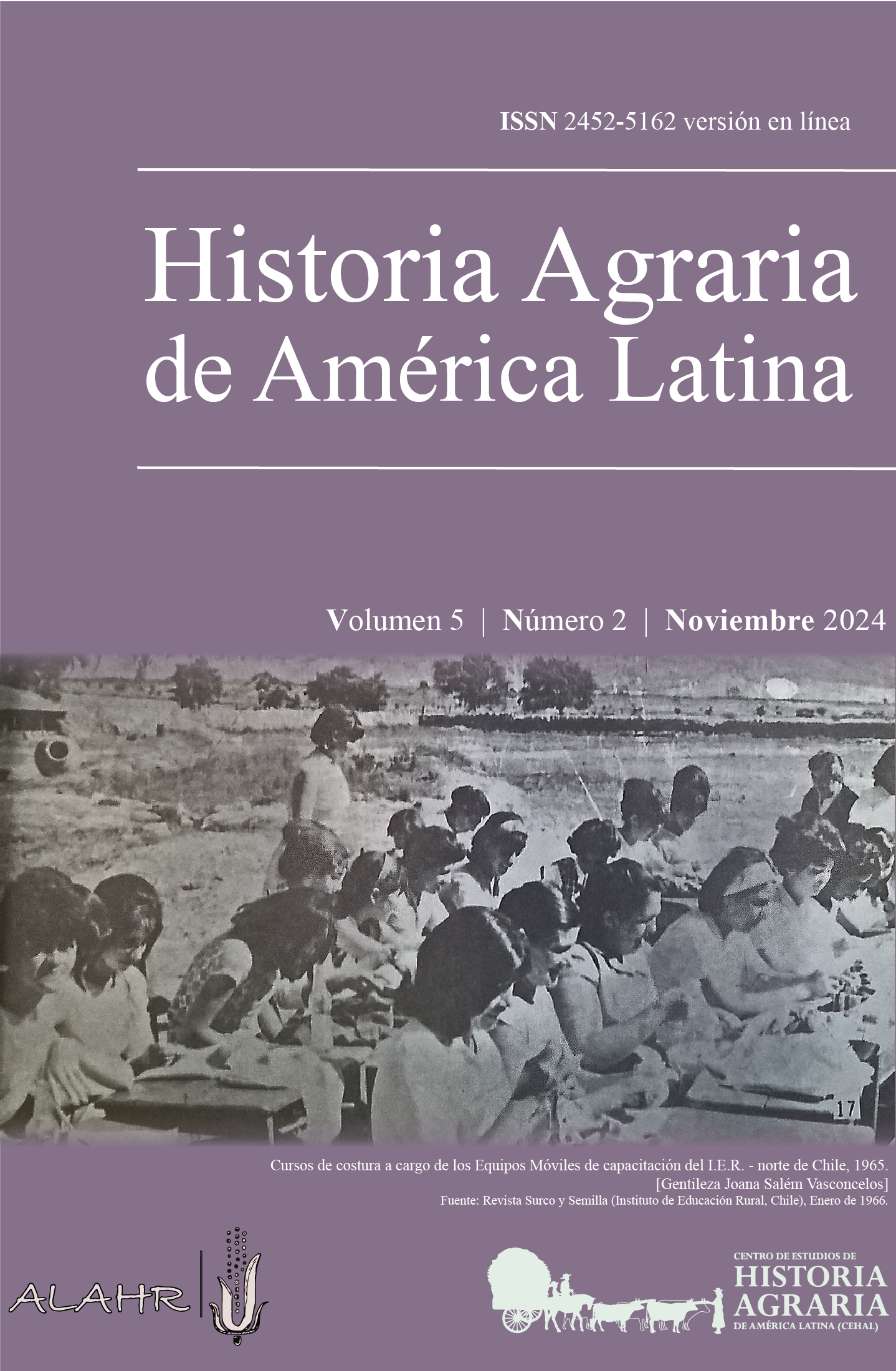
Vol 5No 02November 2024
Issue navigation
Table of Contents
Vol 5No 02November 2024
Dossier: Fronteras de mercancías en América Latina
Abstract
View Article
Download PDF
Download PDF
The paper provides an analysis of the expansion of banana cultivation in Costa Rica during the initial banana cycle (1899-1930), with a focus on the commodification of the fruit and the corresponding frontier expansion. It delves into the significance of land claims on unoccupied lands and the influence of the United Fruit Company on banana cultivation in the Caribbean region of Costa Rica. Special attention is given to the establishment of the political-administrative division of Limón by the liberal governments of Costa Rica. Additionally, it emphasizes the creation of Agricultural Districts within the Limón Division, which were established by the United Fruit Company to facilitate commercial banana cultivation.
Abstract
View Article
Download PDF
Download PDF
Based on the Annual Reports of the United Fruit Company to its shareholders, this article reconstructs and quantifies the processes of land acquisition by the company in the countries of the Greater Caribbean where it operated during the first half of the twentieth century. The data allow tracing the movement of an important part of the banana commodity frontier from the historical core of Limón-Bocas del Toro to the North Central American countries and the Colombian Caribbean. In addition, the article discusses the socioeconomic and environmental causes of the accumulation of a large land reserve, much larger than the area actually exploited. We understand this strategy on the part of the company as a response to the counter-movement of nature in the face of the process of ecological simplification implicit in the formation of plantations.
Abstract
View Article
Download PDF
Este artículo tiene como objetivo analizar la estructura de la propiedad de la tierra en Campinas (Brasil) al final de la expansión de su economía azucarera, subrayando la influencia de la frontera azucarera, conceptualizada por Jason W. Moore. El estudio emplea registros históricos de tierras y datos económicos desde 1790 hasta 1818 para examinar la concentración de la propiedad de la tierra y sus implicaciones socioeconómicas. La hipótesis sostiene que la expansión de la industria azucarera condujo a una concentración significativa de tierras en manos de unas pocas élites. Los resultados muestran que, efectivamente, la introducción del cultivo de caña de azúcar provocó un aumento considerable en la concentración de la tierra y en las jerarquías sociales. Esta investigación contribuye a la comprensión de los impactos locales de la expansión capitalista global y abre nuevas vías para estudios adicionales sobre las transformaciones ecológicas y las desigualdades socioeconómicas en contextos históricos y contemporáneos.
Articles
Abstract
View Article
Download PDF
In this article, I argue that the Institute of Rural Education (IER) was a decisive institution in the Chilean agrarian reform, influencing its paths with a political-pedagogical strategy. Since 1954, IER acted daily in the peasant bases, offering formal education and certified technical training. It built a network of political-pedagogical trust among the Chilean peasantry, vocalizing their subjectivity and values, but also exercising the power to expand opportunities to obtain a plot (parcela). I argue that IER linked peasants with national policy as an institución-nexo, weaving an economic moral made up of three components: sacrifice, meritocracy and cooperativism. Its social-christian cooperativism coexisted with the rejection of communism and the declared sympathy by United States. My sources were the magazine Surco y Semilla, Revista de Educación, materials from Minagri and Mineduc, and interview.
Abstract
View Article
Download PDF
Cattle raising in Sonora has undergone great changes since the colonial period. The bovine species that was bred until the first half of the 20th century, the criollo, has practically disappeared, having been replaced by species with very different genetic attributes, whose reproduction in an arid and semi-arid territory has had negative impacts on the environment. The data analyzed allow us to observe long-term changes both in the way small-scale ranchers relate to the rangelands, the way they understand their characteristics and their sustainability. Variations are also observed in the rangeland coefficients and in precipitation, which is essential for the growth of pastures. These processes of environmental change are studied in a territory constituted of towns with low population density, located next to a surface water course whose presence has favored its development. In the rugged mountains and ranges that channel the river, springs and streams emerge and flow, which along with other geographical elements form the ecosystem where mountain cattle raising has taken place.
Abstract
View Article
Download PDF
This article seeks to explain the expansion and the agro-ecological conditions of potato cultivation in Costa Rica in the 1950-2015 period, and to analyze public policies fostering potato production, such as assistance plans for granting credit and crop insurance. Information and data were gathered from national agricultural censuses (1950, 1955, 1963, 1973 y 1984), field trips, and interviews with individual producers and specialized agronomists. The main argument proposes is that access to credit and crop insurance was unequal and contingent upon agro-ecological risks.