
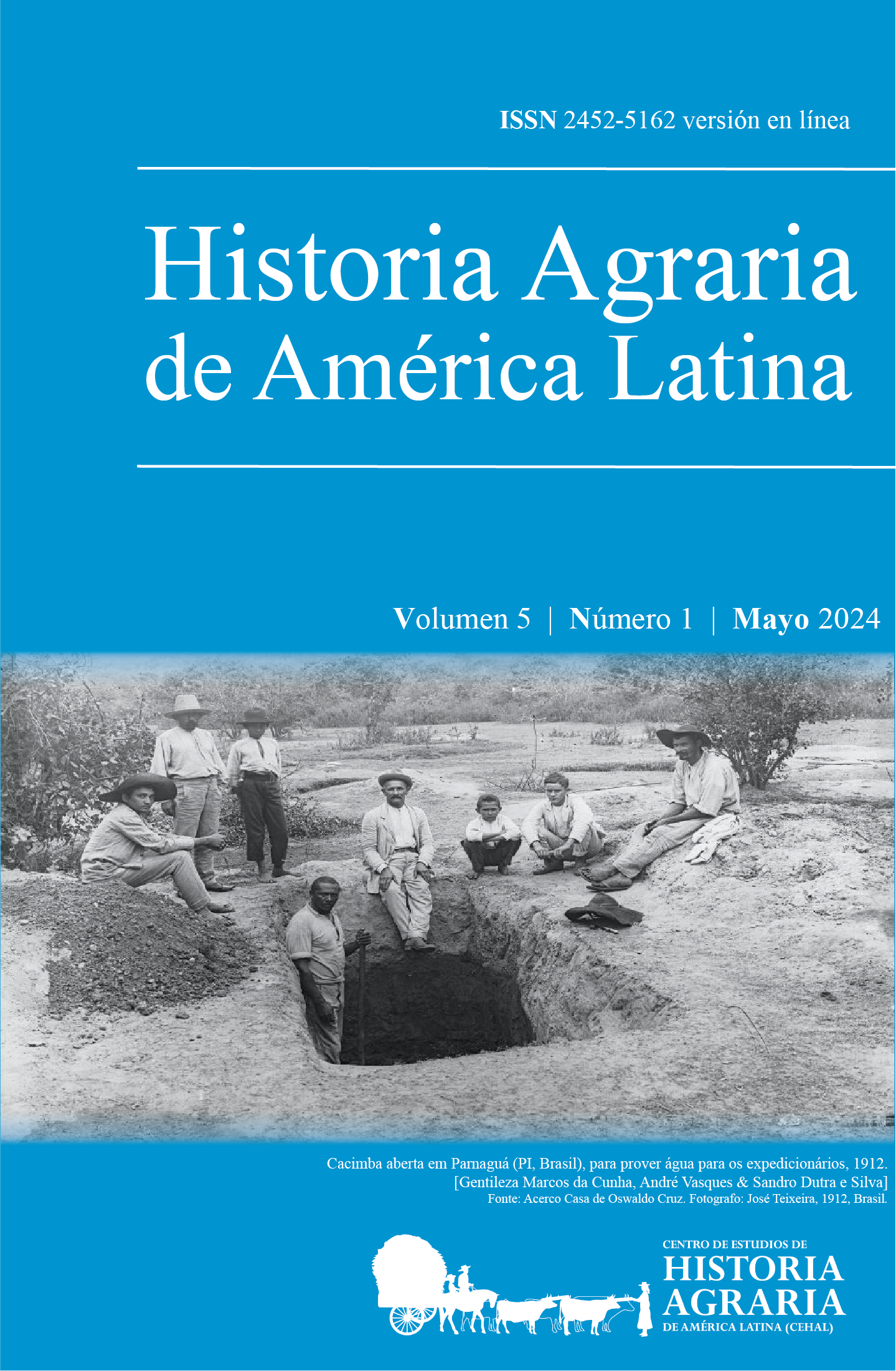
Vol 5No 01May 2024
Issue navigation
Table of Contents
Vol 5No 01May 2024
Introduction
Abstract
View Article
Download PDF
El fuego está en todos los lugares aunque solo vemos una parte de su trama socioecológica (Bowman et al., 2009). En los últimos años, se han vuelto frecuentes las imágenes de grandes incendios forestales en televisión y nuestros teléfonos inteligentes. Se queman por igual, en el Norte y en el Sur global, bosques protegidos, plantaciones forestales, páramos y pastizales con un evidente impacto sobre los ecosistemas y la economía. Enmarcados en el cambio climático, estos incendios, cada vez más extensos y complejos, revelan a la opinión pública un fenómeno que yacía escondido en algunas de las gavetas de la Modernidad. El fuego siempre ha estado allí, en nuestros paisajes e incluso en nuestras ciudades. Pero nuestra mirada no apuntaba a ello, desviaba su atención hacia los artefactos y fenómenos modernos, producidos, salidos de una fábrica y emergidos gracias a la creatividad del capitalismo. El fuego era arcaico. Sin embargo, capitalismo y fuego van de la mano. El capitalismo es una “gran quema”, diría Stephen J. Pyne, una enorme combustión capaz de quemar materia orgánica descompuesta y acumulada durante millones de años. No solo esto. Más allá de la quema del petróleo, el fuego ha prevalecido como un elemento fundamental en la vida de miles de millones de personas en el planeta. Ha sido, y lo sigue siendo, la fuente de energía de millones de familias pobres en el Sur global para calentar sus hogares y cocinar sus alimentos. Y todavía es una herramienta para los agricultores en muchas fronteras agrícolas y constituye un insumo para la agroindustria azucarera tanto como para el monocultivo que crece a costa de los bosques tropicales. La trama del fuego va más allá de los incendios forestales en el presente: está en la matriz social y energética del capitalismo y la Modernidad.
Dossier: fire in the rural world
Abstract
View Article
Download PDF
The article analyzes concerns regarding fires and speculations about a probable process of desertification in the region of Central Brazil, in the first decades of the 20th century, based on the short story “Gente da Gleba”, by Goiás writer Hugo de Carvalho Ramos (1895 -1921). This analysis is carried out by comparing the perceptions of Ramos, local inhabitants, scientists, and travelers at the time about a possible change in the rainfall regime in Central Brazil at the beginning of the 20th century, caused by fires in the dry season and consequent destruction of the forests. This is a study possible through an approach that brings together Environmental History and Ecocriticism when investigating how non-humans impact a literary work in a given historical period. The concerns outlined in the work “Gente da Gleba” are related to different perspectives on the Cerrado biome and the management of fire in this area, at the beginning of the 20th century, but also with desiccation theories, which were a set of scientific ideas that forged a direct association between deforestation and climate change at the local level.
Abstract
View Article
Download PDF
This work analyses in the long term (since the 18th century) the evolution of peasant fire management in Galicia (northeast Spain). Also, the emergence of forest fires as a consequence of the process of industrialization of agriculture and the breakdown of the agro-ecosystems in mosaic characteristic of peasant management. It is studied the functionality of the estivadas (shifting cultivation) in organic agriculture, its integration in the set of peasant management of the mountain. Attention is also paid to changes in the management of manure during the process of intensification of organic agriculture between 1750 and the 1930s. Finally, we study the rupture of peasant management forms first by the policies of the Franco dictatorship and then by the impact of the industrialization of agriculture. The links between the latter process and the emergence of fires as a recurring problem since the 1970s are analysed.
Abstract
View Article
Download PDF
The present work eamines a swidden implanted according to the caiçara’s culture, a traditional population of part of the Brazilian coast, to determine aspects related to its ecological sustainability. This type of swidden begins with cutting down an area of forest and burning it. The nutrients balance was made through the following evaluations: a) phytomass and nutrients stored in the forest (soil and vegetation); b) ashes contribution to nutrient stocks in the soil; c) productivity of a crop (beans), and d) balance of soil nutrients between planting and harvesting. When comparing the soil under the two systems (forest and swidden), it is verified the occurrence of gains of 21.3% of P and 24.9% of K and losses of 15.3% of organic matter, 37.3% of Ca, and 31.6% Mg. In the cultural and technological context in which fire is used in crops, it is highly efficient in transforming forest biomass that is unpalatable to man into food.
Articles
Abstract
View Article
Download PDF
This work studies the factors that allowed the identification of the indigenous people with the Spanish Crown and their subsequent rejection. Through information form unpublished documents we propose that a significant sector of the indigenous people of Huamanga defended the Bourbon administration, because they enjoyed tax privileges, possibilities of ‘Spanishization’, continuity in their positions of chiefs, greater economic income, exemption from taxes, defense of communal lands and, health and education benefits. However, towards the last years of the war the imposition of tithes, imprisonment for non-compliance with the mitas de tambo and illegal alcabalas, and, fundamentally, war contributions motivated the breakdown of loyalties. That is to say, the actions of the indigenous people were not static and, on the contrary, loyalty or rejection of the Crown depended greatly on the administrative policies and each group’s interests.
Abstract
View Article
Download PDF
Este artículo repasa las trayectorias de movilización campesina en Montes de María (norte de Colombia) entre 1950 y 2000. Esa revisión resalta que dichas trayectorias obligaron a los actores involucrados a negociar sus diferencias y acordar colaboraciones en la década de 1980. A partir de ese análisis, el artículo establece que dichas trayectorias fueron parte de un proceso más amplio de democratización. El objetivo es entonces proponer una discusión sobre los nexos entre movilización campesina y democratización en América Latina durante este período. De hecho, historias agrarias han mostrado cómo la movilización campesina ha moldeado instituciones políticas formales. No obstante, para complementar estos hallazgos, el artículo le apuesta a historizar la democratización como reducción de desigualdades políticas. La democratización así entendida rebasa las instituciones políticas formales y se observa mejor en cambios en las relaciones sociales. Es el caso de los campesinos en Montes de María, empeñados en reducir las desigualdades políticas entre ellos mismos y con respecto a otros actores sociales.
Abstract
View Article
Download PDF
This article addresses the contradictory relationship between policies oriented towards economic growth and policies aimed at ecological sustainability in the case of Chilean fruit production. The history of growth of this sector is confronted today with the scenario of the global climatic and ecological crisis and the national water crisis, which poses fundamental challenges. The encounter between these historical trends is analysed from a multi-scalar and relational perspective of geographical space and applying the scientific literature on degrowth to this case. The study is based on semi-structured interviews with different actors in the Chilean fruit industry as well as critical observers, documents and statistics and fieldwork in Chile. The analysis leads to the conclusion that many of the sustainability policies currently applied to the Chilean fruit sector are limited by the same factors that limit environmental policies at the global level, such as rising energy and resource expenditure, rebound effects, problem shifting and insufficient and inappropriate technological change. Limits that can be overcome by developing a strategy to transform the sector beyond the goal of unlimited growth. In this way, the article contributes to the literature on degrowth with a territorialised and multi-scalar case study on the one hand, and to the literature on agrarian history and policy in Chile on the other hand, by linking it to global ecological challenges.