
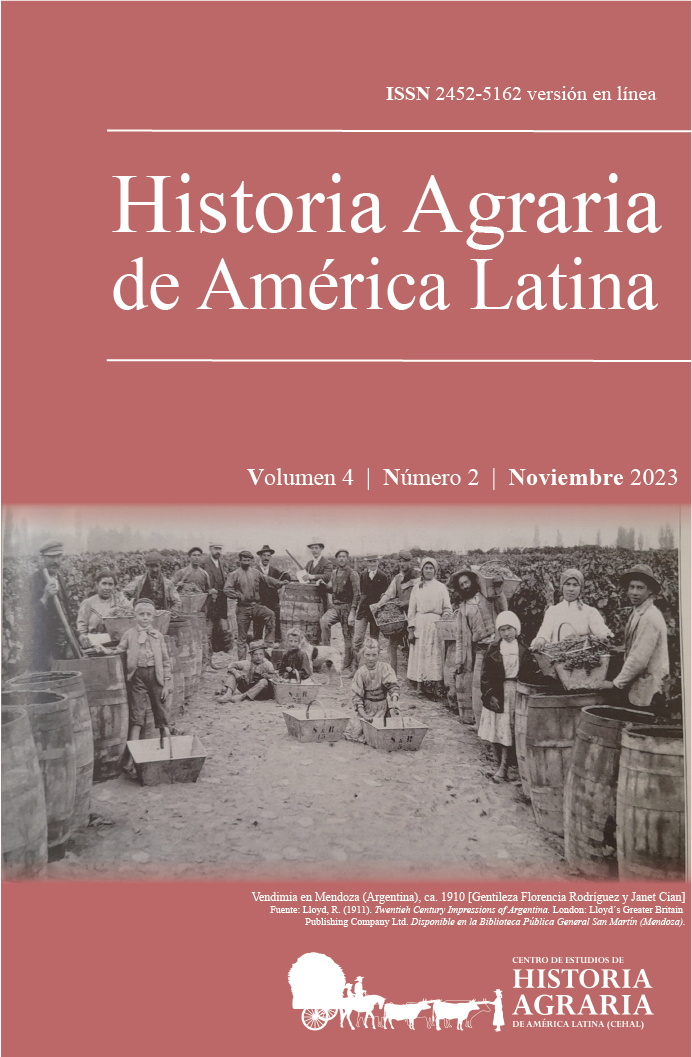
Table of Contents
Vol 4No 02November 2023
Articles
Abstract
View Article
Download PDF
The analysis of professional trajectories in historical perspective allows us to understand the functioning of institutions, the circulation of knowledge and disciplinary formation, as well as the reception of these inputs, particularly in modern agroindustries. On this basis, the article reconstructs and reflects on the career of the winemaker José Alazraqui. The study will shed light on the modalities of generation and circulation of knowledge and techniques of the Ministry of Agriculture of the Nation in relation to Argentine viticulture, as well as the degrees of exchange and growing interaction among specialists, economic agents and institutions with similar purposes. As an evaluation of that trajectory, we document Alazraqui’s significant contributions in viticultural pathology, an area of concern for wine-growers in different parts of the country. The article is based on reports from Ministerio de Agricultura de la Nación and Estación Enológica de Concordia, newspapers from Mendoza and Entre Ríos, specialized technical publications and unpublished reports prepared by Alazraqui.
Abstract
View Article
Download PDF
The present article attempts to re-centre and localise the inspection conducted by Potosí Corregidor and viceroy lieutenant don Pedro Osores de Ulloa in 1596 in the Tomina frontier, approaching the event through the political culture of the time. With the help of letters, reports of merits and services, and notarial records, the inspection is understood as the staging and renegotiation of multiple jurisdictions with the aim of preserving the frontier’s status quo. The inspection was not planned to alter the zone’s political dynamics but to confirm and strengthen the existing jurisdictions of the agents present in the area. The visita’s journey maps these jurisdictions and the political hierarchies that underpinned them.
Abstract
View Article
Download PDF
This essay analyzes the destructive nature of capitalism from an environmental perspective. First, it examines the concept of creative destruction, a term coined by the Austrian economist Joseph A. Schumpeter, and proposes in its place the concept of “destructive creation” as a way of understanding the impact of capitalism on the Earth system. Second, it argues that the Anthropocene and the Great Acceleration are examples of a biophysical destructive creation dynamic that is characteristic of capitalism. Third, it suggests that during the second half of the twentieth century there existed an intellectual destructive creation, linked to the predominance of the concepts of development and sustainable development. Finally, it examines the concepts of post-development and post-capitalist transitions as forms of destructive creation within capitalism.
Dossier: fire in the rural world
Abstract
View Article
Download PDF
Forest fires have been a central issue for different disciplines, contributing to their analysis from multiple perspectives. Agrarian history has been one of them, however, it is possible to notice a gap even in historiographies addressing the study of fires and its uses the one which is related to the role of women and gender. This paper offers an approach to this topic based on a case study focused on Galicia (Spain), an area marked by a high impact of fires and where the culture of fire has undergone a great transformation throughout the 20th century.
Abstract
View Article
Download PDF
This article studies the relationship between fire and cattle ranching in the valley of the Sinú and San Jorge rivers, one of the most historically and productively important cattle-raising regions in Colombia during the 20th century. The text describes and analyzes the interactions that ranchers established with fire, its uses and effects on pastures, animals, soils, forests, savannas, and livestock production. The article is based on the correspondence of ranchers, travelers’ accounts and geographical descriptions, as main sources, which allow reconstructing the uses, stages and repercussions of fire on livestock activities in this Caribbean region. In theoretical terms, the article draws on the approaches of the History and Ecology of Fire to demonstrate that the practice of burning pastures in the formation and maintenance of pastures was part of a fire regime and a livestock pyroculture.
Abstract
View Article
Download PDF
This paper investigates the relationship between hegemonic economic rationality and the environmental crisis, with fire as the common thread. Based on Warren Dean's work, "A ferro e fogo" (With broadax and firebrand), we delimited the Doce River Basin (DRB), in the Southeast Region of Brazil, as a unit of analysis to understand the circumstances that led us to the current situation and, from there, to reflect on future possibilities for changing the status quo. In a dialog between the works of Espindola (2009; 2011; 2015; 2022) and Pyne (2016), we point out the possibility of going against the degradation tide that leads us to the Pyrocene.