
Table of Contents
Vol 3No 02November 2022
Articles
Abstract
View Article
Download PDF
Download PDF
La década de 1850 fue un período de transformación para la economía de Chile asociado a la Fiebre del Oro de California y los booms mineros en Australia y el norte chileno. La Fiebre del Oro produjo enormes ganancias para los terratenientes de Chile Central que proveían de trigo y otros productos agrícolas a los recientemente abiertos mercados de exportación. Hacia 1855 los grandes terratenientes eran ricos de acuerdo al valor de sus propiedades, pero no podían obtener crédito hipotecario para hacer inversiones en regadío. En agosto de 1855, el Congreso aprobó la legislación para crear un banco hipotecario estatal, la Caja de Crédito Hipotecario. Cinco años después de que la Caja hiciera sus primeros préstamos, el país experimentó una devastadora crisis hipotecaria. La Caja se vio forzada a tomar posesión y liquidar las propiedades de muchos terratenientes. En los años subsiguientes el crédito hipotecario se recuperó. Más de 160 años después, BancoEstado, el sucesor directo de la Caja, es el tercer banco más grande y el único público, el más importante banco hipotecario y la institución financiera más antigua de Chile.
Abstract
View Article
Download PDF
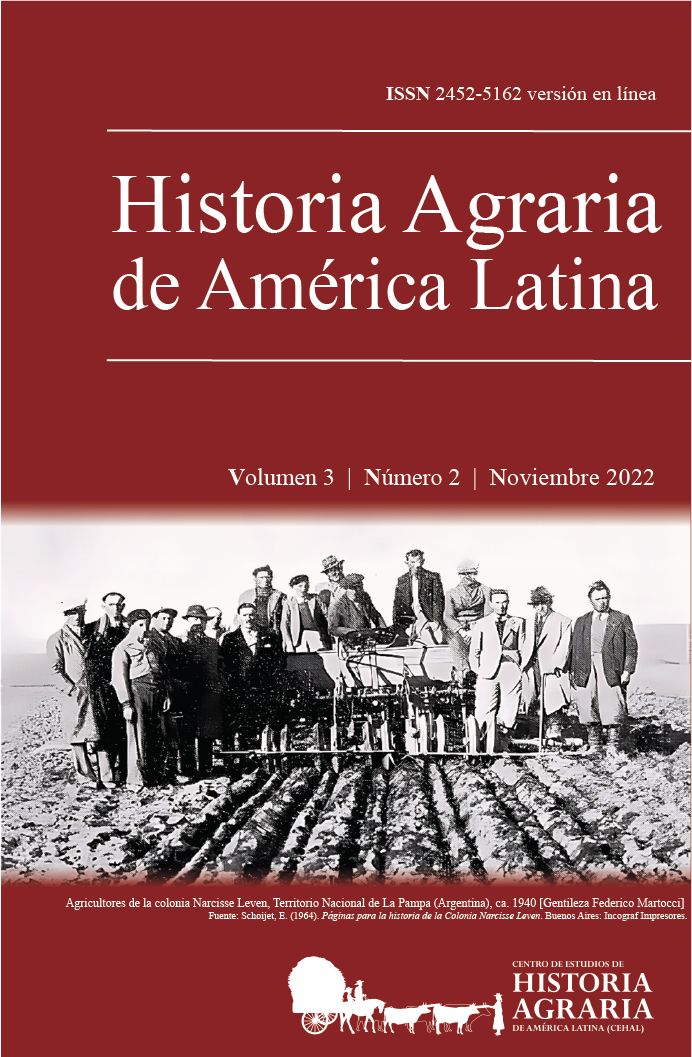
From a perspective based both on agricultural history and environmental history, this article analyzes the efforts made by Jewish farmers in the Narcisse Leven colony and the role of the Guatraché experimental station, to deal with extreme drought on the Pampa Seca region in 1930-31, a critical juncture for agriculture in central Argentina that was contemporaneous to the US Dust Bowl. We explain the conservation alternatives tried out from the late 1930s to the mid-1940s in a region posing, from an agro-economic view, huge challenges for the farmers who expected to get yields from working the land. This critical situation forced the State to set up agencies and carry out studies on the erosion process to advise farmers, who also tried out new tilling methods to conserve the soil. Thus, as severe drought, loss of soil fertility and wind erosion called into question the feasibility of farming, Jewish farmers and state agricultural experts worked together to develop dry farming practices that allowed them to obtain higher yields and to conserve the soil.
Abstract
View Article
Download PDF
This article analyzes the problems of land ownership and the affectation of the land legally granted to indigenous reservations in the northeast of the New Kingdom of Granada during the 17th and 18th centuries, and the conflicts raised with the growing number of white and mestizo neighbors. From the perspective of social history and inter-ethnic relations, this analysis rests on the revision of the litigation for the widening of reservations, the plundering and the constant vulnerability of the borders that separated the indigenous territory from the rest of its environment. In the midst of a changing social and ethnic context, many were the difficulties and disadvantages experienced by the indigenous community in the face of the complex judicial process, and the power displayed by the free peasantry.
Abstract
View Article
Download PDF
La creciente riqueza en el mundo en los últimos setenta y cinco años ha llevado a una cada vez mayor demanda de proteína animal barata. Mientras que la moderna carne de pollo o la industria broiler fue desarrollada primero en los Estados Unidos y Europa Occidental, hoy es Brasil el principal exportador de pollos broiler. Este artículo examina el origen y expansión de esta industria en Brasil, explicando cómo y por qué este país ha emergido como el principal exportador mundial tanto de carne de pollos broiler en general, como de carne de pollo halal en particular.
Abstract
View Article
Download PDF
This article examines the origins of the small property in the municipality of Amatlán and its evolution in the context of the oil boom that took place in Mexico during the years 1910 to 1921. We argue that the fragmentation of the condueñazgo of Amatlán carried out at the end of the 19th century did not mean the triumph of the “perfect” private property that the liberal elite promoted, but this did not stop the land market or oil exploitation in subsequent years. On the other hand, the small property made possible the incursion of national and foreign tenants in the municipality, the intense speculative activity and the accelerated exploitation of the oilfields. In addition, the irregularity of the titles played an important role in the conflicts that arose during and after the period of oil effervescence, once the Mexican Revolution gave a turn to the property rights policy in the country.
Abstract
View Article
Download PDF
In Mexico, the ways of understanding agrarian legislation, applying it, deviating from it, or simply ignoring it, are innumerable and vary from one ejido to the next. Many of the practices involved may have been illegal, but that does not mean they lacked social legitimacy. The reform of Article 27 in 1992, whose objectives included establishing a new form of private property and integrating land into commercial markets, also sought to normalize those practices and homogenize ejidatarios relations with their territories. This study analyzes the history of two ejidos in the central area of the state of Veracruz based on a detailed review of agrarian archives and fieldwork. These ejidos present enormous differences over time in both their practices and “ways of being ejidos”. The article aims to assess whether the 1992 reform has achieved its goals of normalization and homogenization, whether it has been a watershed in practices related to ejidos lands, and wether it has done away not only with social property, but also with the idea of community.